

Damp
The UK’s housing stock is particularly susceptible to damp. One of the main reasons is that our housing stock is some of the oldest in Europe, and the way our homes were built causes inherent problems.
Most residential properties built before 1920 have solid brick external walls, which don’t protect against damp as well as their modern counterparts with cavity walls. The damp proof courses (DPCs) used in older walls to stop rising damp often use inappropriate materials, and many have since failed. A lot of houses from this era also still have slate roofs, which can be more susceptible to damp if they are damaged or corroded. And, of course, the UK’s wet weather doesn’t help.
The three main types of damp that can affect a residential property are rising damp, penetrating damp and condensation.
Rising Damp
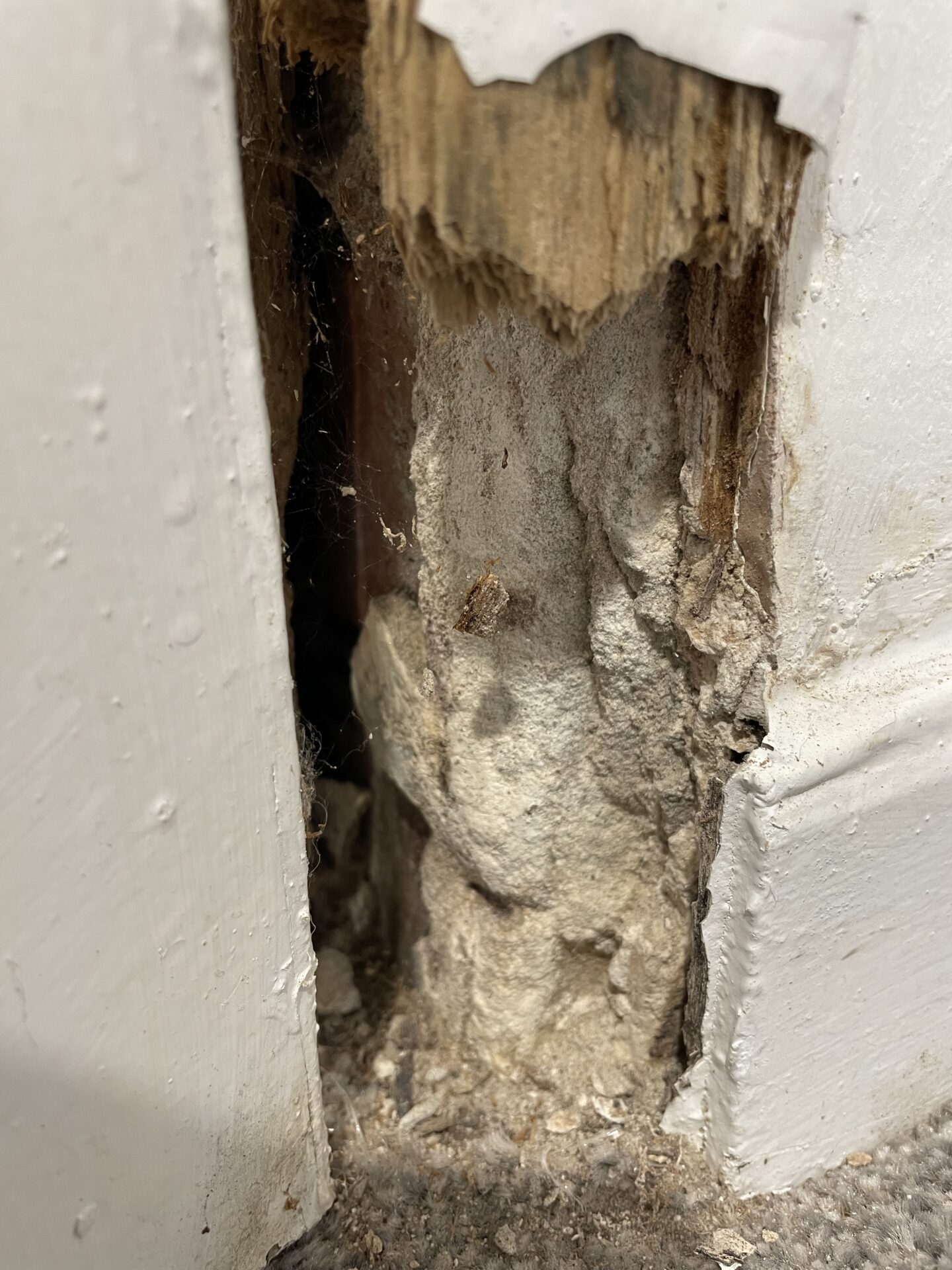
Rising damp is more prevalent in older solid brick walls due to failed DPCs (see figure below) and a lack of cavity in the external walls.
Why else does it happen? The DPC might be bridged. Bridging of the DPC occurs when plants, debris, external wall coverings (render) or external floor coverings (drives, flagging or concrete) are near to or above the DPC level. Water can then travel across the top of the DPC through the brickwork.
Rising damp can occur with both solid and suspended timber ground floors. It is particularly damaging to suspended timber flooring, as it can cause the timber to rot. If you see rising damp in a property, it could require £1,000s of repairs to the walls and floors.
Penetrating Damp
Penetrating damp is the act of rain directly entering a property. It can come through defective rainwater goods, or through the walls, windows, doors, roof or chimney (more on the last two below).
Leaking rainwater goods are a big cause of penetrating damp. Gutters are often blocked, joints or sections of gutters and downpipes are loose or missing, and there could be insufficient capacity. On many older properties the gutters and downpipes are made of metal or cast iron that is prone to corrosion and leaking. Problems with the rainwater goods might be evident from stained joints, stained walls or joinery below or close to a joint. Internally, the damp is likely to be at the top of the walls on the upper floors and can result in damaged wall coverings, staining and damaged plaster.
Walls are susceptible to penetrating damp for many reasons. Wind and rain can often saturate exposed areas of the brickwork. The pointing (mortar between bricks) can be missing in places, the render might be cracked or damaged, or the bellmouth drip (bottom of a rendered wall) or window sills might not be sufficient to allow rainwater to drip away from the wall. Windows and doors are also a cause of penetrating damp, moisture can enter the property through failed seals and joints.
Condensation
Condensation is the most common form of damp in a home, some studies have found it in up to 1 in 5 homes. Unlike rising damp or penetrating damp, which come from external factors and building construction issues, condensation is often caused by the lifestyle of the occupant.
Now for another bit of science. Condensation forms when the air in the property reaches its dew point. The dew point is when the air is cooled to such a point that it becomes saturated with moisture and this moisture can’t be held as a gas any longer, at this point, dew is formed. Think of a window in winter: the window is cold due to the cold air outside, while inside the home the air is warm and moist. The warm inside air comes into contact with the cold window, cooling to the point that the dew point is reached, and moisture is released onto the window.
Effective ventilation is the key to reducing condensation. If the amount of moisture in the air can be reduced, the occurrence of the dew point can be avoided. Kitchens and bathrooms need working mechanical extractor fans, and simply keeping windows or their trickle vents slightly open in winter can also make a big difference.
Roofs are also a big cause of condensation. A lot of roofs do not have any ventilation, so warm air from the house rises and comes into contact with the cold underside of the roof covering, causing condensation. Adding roof tile vents is a cheap and effective way to ventilate roof spaces, and a lack of roof vents could indicate that condensation might be an issue.
Solid brick walls are more prone to condensation, as the inside surface can become cold and cause the dew point to be reached. In more modern houses with cavity brick walls the occurrence of condensation is a lot less, as the two layers of brick help prevent the inner skin becoming excessively cold, cavity wall insulation also plays a role in reducing condensation. But be aware: modern houses can still be affected by condensation if there is little or no ventilation, as excessive moisture can get trapped.
Black mould in a house is the clearest sign a property is suffering from condensation. Moist and warm conditions are perfect for mould to grow. It can be more prevalent in kitchens and bathrooms, as these create more moisture, and it is also more likely to occur on external walls and around windows.
Roof and Chimney Defects
Roof and chimney defects can result in £1,000s of repairs.
Defective roofs can cause penetrating damp, as water can enter the property through the roof coverings. The defect might be as simple as a missing, damaged or slipped tile. The mortar bedding under the ridge tiles (the top of the roof apex) or hip tiles (running from the ridge to the top of the external wall on a hipped roof) might be missing.
The chimney can also cause penetrating damp. The flashing might have failed or lifted, the chimney pots might be open, or the mortar the pots sit on (the flaunching) might be cracked. Chimney defects can be a significant cause of moisture entering a property.
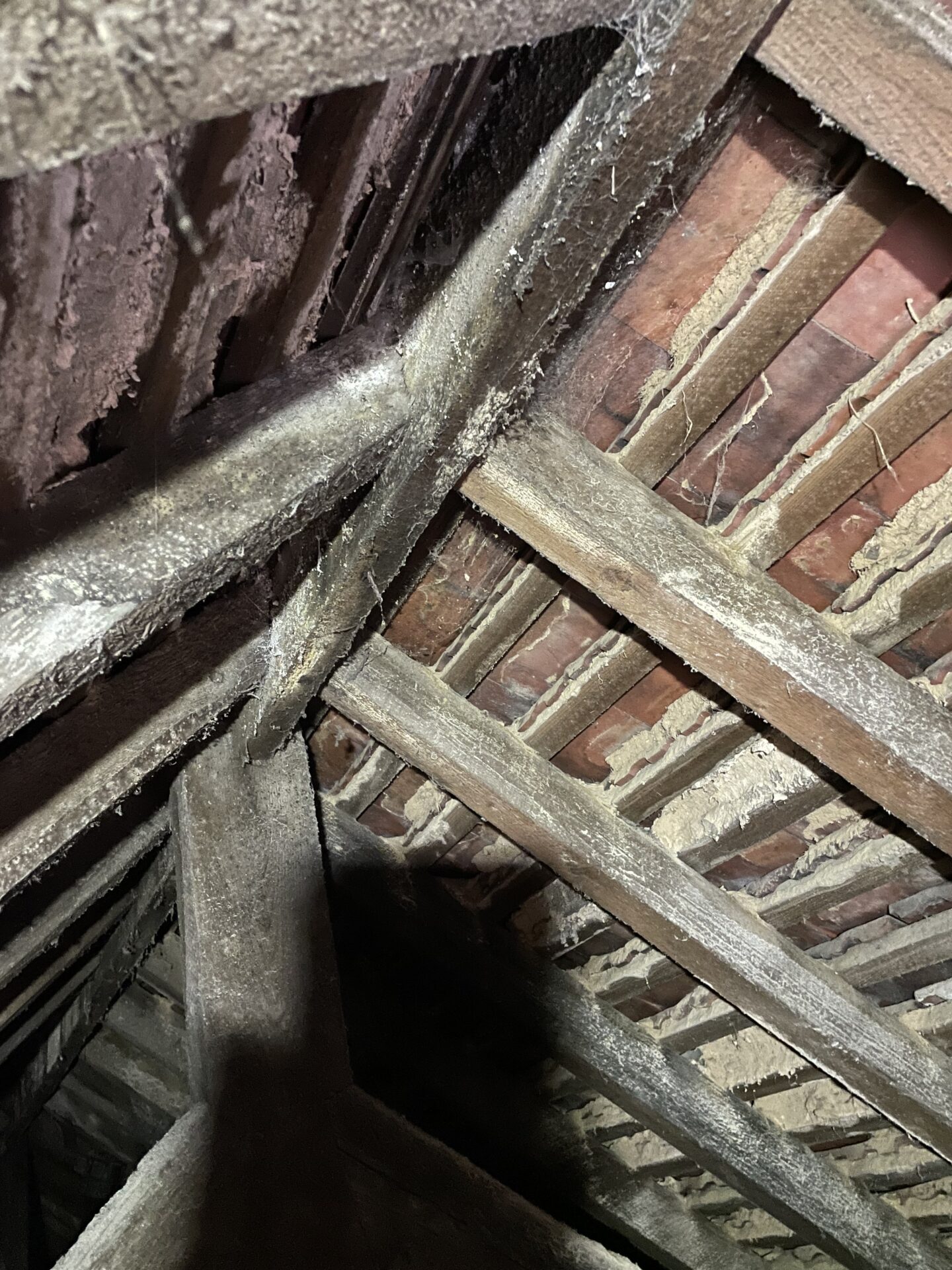
In the roof space, the condition of the roof membrane can be seen. An effective roof membrane collects water that gets through the roof coverings and channels it to the rainwater goods, preventing internal damp. Signs of a defective membrane can be mortar-like dust and debris in the roof space, and being able to see the back of the tiles (see figure below). The mortar used on the inside of roof tiles is lime torching, which was historically used on older properties to seal the inside of the roof covering, replacing this with a modern equivalent can be expensive.
Structural Defects
There are a lot of potential structural issues that can be found in a residential property. Their cause and effect can be difficult to pinpoint, and specialised advice should always be sought if there are any concerns.
The major indicator of structural issues is a significant size or number of cracks to the external masonry or inside plaster finishes. Cracks occur when there is differential movement between the building materials and the ground the property is on.
According to the Building Research Establishment (BRE) in their Digest 251, there are six categories of cracks. Categories 0 and 1 are at the lower end of the scale, defined as internal cracks up to 1mm in width. These can easily be filled when decorating and are likely to return; they are common in internal walls and ceilings.
In a property with structural issues there might be a lot of cracks and/or cracks over 2mm in width (see figure below). The areas around doors and windows are particularly susceptible to cracks if there is differential movement, these are often evident as 45-degree cracks.