When something goes wrong underground, the first question is usually the most important one: whose problem is it?
Many homeowners are surprised to discover that not all pipes beneath and around their property are their responsibility. Whether you’re dealing with a blockage, planning an extension, or considering a CCTV drain survey before buying a property, understanding the difference between a drain, a lateral drain and a sewer can save you significant time, money and frustration.
Here’s a clear breakdown of what each term means, and what that means for you as a homeowner.
What is a drain?
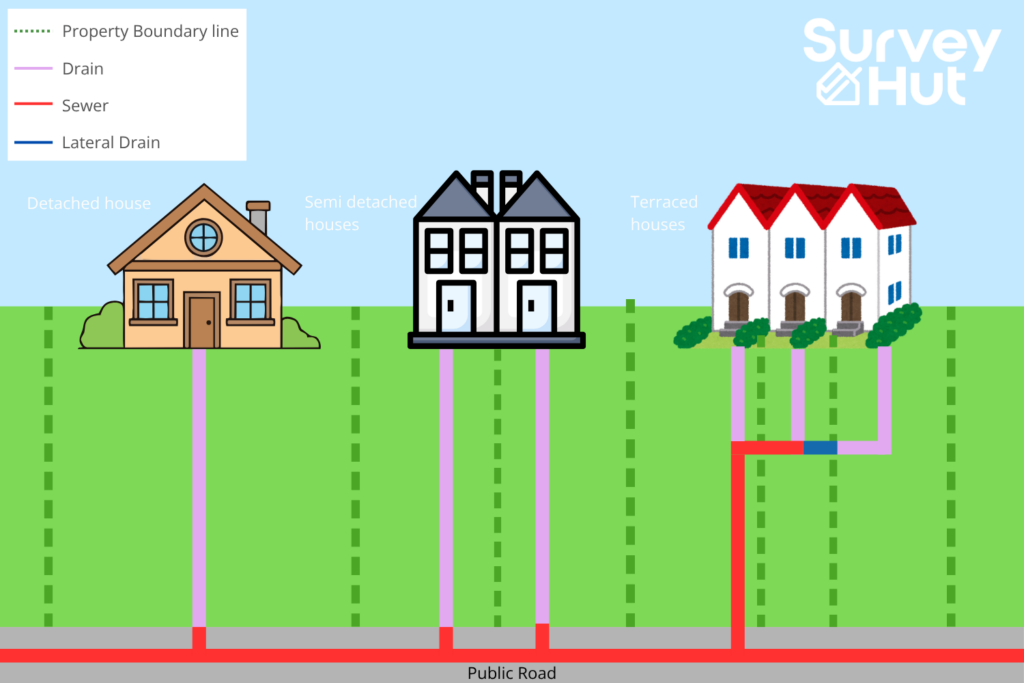
A drain is the pipework that carries wastewater away from a single property. This includes water from your sinks, toilets, baths, showers and washing machines, as well as surface water from gutters and driveways where connected.
As a homeowner, the drains within the boundary of your property are your responsibility. If a drain serving only your home becomes blocked, collapses or needs repair, the cost of sorting it out falls to you.
This is one of the key reasons a CCTV drain survey is so valuable when buying a property. A visual inspection of your private drainage reveals the condition of pipework that a standard home survey simply cannot see, and any problems identified are yours to deal with once you own the property.
What is a lateral drain?
A lateral drain is the section of drainage pipe that carries wastewater from your property boundary to the public sewer. It’s essentially the continuation of your private drain, but once it crosses the boundary of your property and runs beneath shared or public land, it becomes something different entirely.
Since 2011, responsibility for lateral drains in England and Wales transferred from individual homeowners to the water and sewerage companies. This was a significant change, before that, you could have been liable for pipework running under a public pavement or shared driveway, even though you had no practical ability to access or maintain it.
Today, if a lateral drain fails in the section beyond your property boundary, your water company, United Utilities in the North West, is responsible for its repair, not you.
What is a sewer?
A sewer is a pipe that carries wastewater from more than one property. This is the critical distinction. The moment drainage from two or more homes joins together, it becomes a public sewer, and public sewers are the responsibility of the local water and sewerage company, regardless of where they run.
This includes sewers that run directly beneath private gardens and driveways. Many homeowners are unaware that a public sewer can pass through their land, but that doesn’t make it their problem to maintain. United Utilities, as the water authority for the North West, is responsible for the upkeep, repair and replacement of public sewers.
What this does mean for homeowners, however, is that you cannot simply build over a public sewer without permission. If you’re planning an extension or outbuilding within three metres of a public sewer, you’ll typically need a build-over agreement from United Utilities, and that process usually requires a CCTV drain survey to establish the sewer’s current condition before any work begins.
Why does this matter when buying a property?
When you’re purchasing a home, understanding the drainage picture is essential. A standard Level 2 or Level 3 Home Survey will not include an inspection of underground drainage. Defects in your private drains, cracked pipes, root ingress, displaced joints, or early signs of collapse, are entirely invisible without a camera inspection.
Commissioning a CCTV drain survey before you exchange contracts means you know the condition of the pipework that is your responsibility before it becomes your problem. Any defects identified can be used to renegotiate the purchase price or request repairs from the seller prior to completion.
It also helps establish whether any drainage running through the property is private or public, useful information if you’re planning future development.
A simple way to remember it
- Drain – serves your property only, runs within your boundary. Your responsibility.
- Lateral drain – continues beyond your boundary to the public sewer. Water company’s responsibility.
- Sewer – carries waste from more than one property. The water company’s responsibility is wherever it runs.
If you’re unsure about the drainage at a property you’re buying or currently own, a CCTV drain survey is the most reliable way to get a clear picture. Get in touch with Survey Hut to find out more or request a quote.